Disclaimer: This analysis is for educational purposes only and does not constitute investment advice. Stock market investments carry risk. Consult a financial advisor before making investment decisions. Past performance does not guarantee future results. This analysis is based on data available as of November 18, 2025, and market conditions are subject to change.
The Demerger Story: What We Were Promised
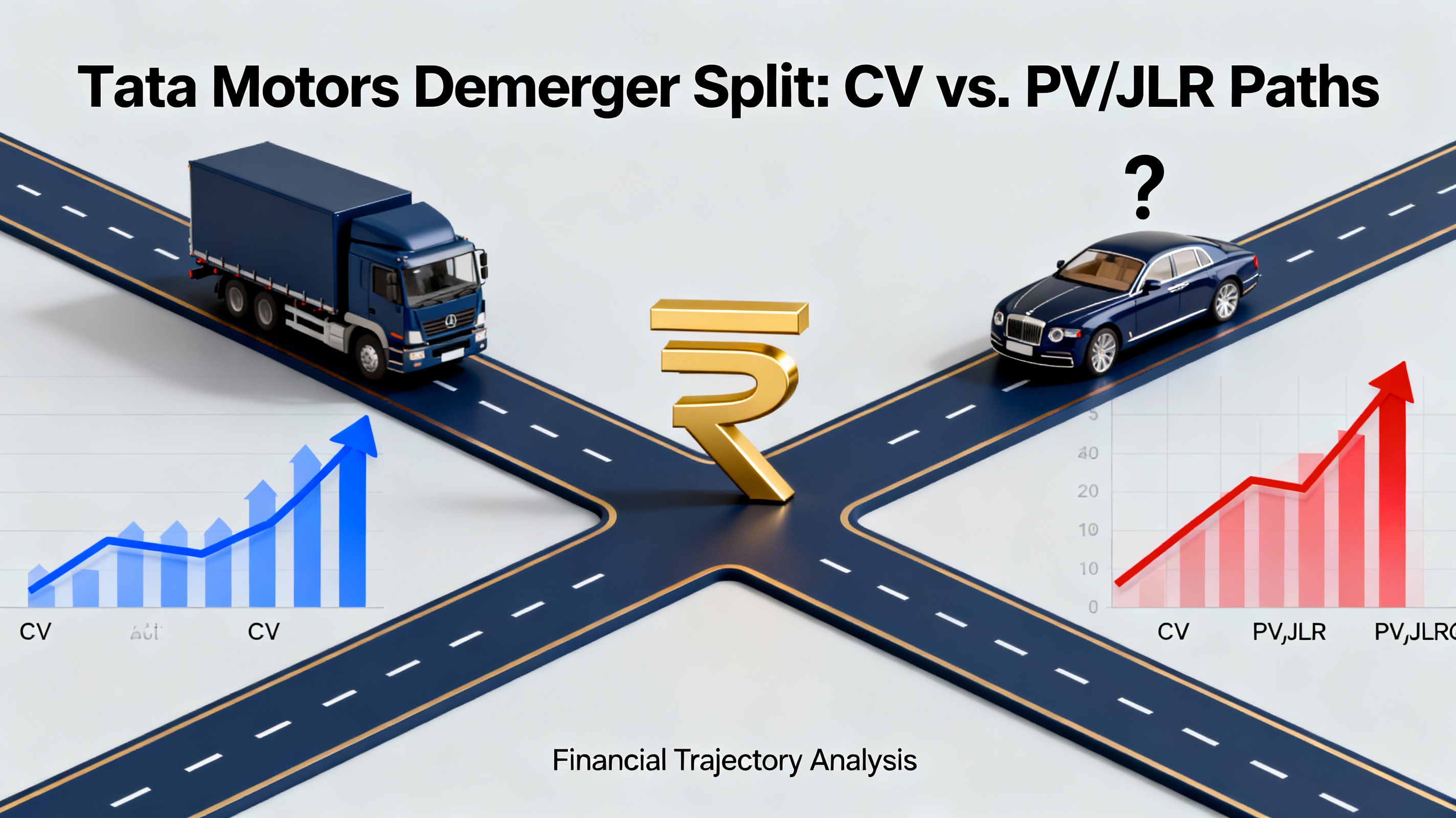
When Tata Motors announced its demerger in March 2024, the narrative was compelling: separate the fast-growing Passenger Vehicles (EV + Premium JLR) business from the stable, cash-generative Commercial Vehicles business. Each would be valued independently, removing the “conglomerate discount,” and shareholders would unlock hidden value.
The market responded positively. Brokerages lined up with bullish targets. Investors imagined the CV unit would trade at a premium due to strong cash flows, and the PV unit would command a higher multiple thanks to JLR’s luxury positioning and India’s EV transition.
Fast forward to November 2025. Reality is… more nuanced.
The Numbers: Combined Value Comparison
| Metric | TMPV (PV Business) | TMCV (CV Business) | Combined Total |
|---|---|---|---|
| Current Price (Nov 18, 2025) | ₹372.70 | ₹328.50 | ₹701.20 |
| Pre-Demerger Implied Price | ₹454.93 | ₹205.82 | ₹660.75 |
| Premium / (Discount) | -18.07% | +59.60% | +6.12% |
| Cost Allocation Ratio | 68.85% | 31.15% | 100% |
Key Insight:
The combined market value of both stocks has appreciated by ₹40.45 per share (+6.12%) since the pre-demerger price of ₹660.75. This means:
- Value WAS unlocked, but modestly (6.12% gain over 1+ month)
- The gains have been unevenly distributed between the two entities
- Not exactly the “Free Money” narrative we hear on Twitter/Reddit
The Real Story: Winners and Losers
TMCV (Commercial Vehicles) – The Star Performer ⭐
TMCV listed on November 12, 2025, with a 28% premium over its implied value of ₹260.75, debuting at ₹335 on NSE.
| Scenario | Details |
|---|---|
| Listing Premium | 28.48% over implied value |
| Current Vs. Implied | ₹328.50 vs. ₹205.82 = +59.60% |
| Reason for Rally | • Strong CV demand cycle (infrastructure spending) • Iveco acquisition (€3.8B) offering global scale • Market leader in India’s truck/bus segment • Stable cash generation attracts cyclical buyers |
| Analyst Target Range | ₹320–₹470 (SBI Securities) |
| Net Profit FY25 | ₹6,132 crore (vs. ₹2,869 crore in FY23 = +114%) |
The Arbitrage Play: If you bought 1,000 TMCV shares at the discovered price of ₹260.75 and held them until now, you’re sitting on a ₹67,750 gain (assuming ₹328.50 current price). That’s a 26% return in days.
But here’s the catch: This premium may not last. Trade-for-trade mode (10 sessions of restricted trading) was designed to prevent exactly this kind of FOMO buying. Once unrestricted, volatility could reset the price.
TMPV (Passenger Vehicles) – The Underperformer 📉
TMPV has been disappointing post-demerger:
| Metric | Details |
|---|---|
| Current Price | ₹372.70 |
| Implied Cost Allocation | ₹454.93 (based on cost split) |
| Current Discount | -18.07% |
| Since Demerger Record Date (Oct 14) | Down 40.5% from ₹660.75 |
| Analyst Concerns | • JLR facing challenges (contributes 45% of revenue) • Domestic PV competition (Maruti, Hyundai) intensifying • EV profitability uncertain • Capex-heavy model vs. CV’s cash generation |
| Analyst Target Range | ₹285–₹384 (SBI Securities); Nomura: ₹367 |
The Reality: TMPV has been selling off since the demerger became effective. Why? Because the market is repricing expectations:
- JLR’s recovery narrative is stalling – Component shortages, weak global luxury demand
- EV investments are capital-intensive – Unlike CV’s steady cash flows, PV needs continuous capex
- Valuations got compressed – The conglomerate discount is being applied separately now
The Investment Perspective: Who Made Money?
Let’s analyze a real scenario for an investor who held Tata Motors before October 14, 2025 (record date):
Example: Original Investment of ₹4,00,000 (1,000 shares @ ₹400)
| Entity | Shares Received | Cost Allocated | Current Value | Gain/(Loss) | Return % |
|---|---|---|---|---|---|
| TMPV | 1,000 | ₹2,75,400 | ₹3,72,700 | +₹97,300 | +35.33% |
| TMCV | 1,000 | ₹1,24,600 | ₹3,28,500 | +₹2,03,900 | +163.64% |
| Combined | 2,000 | ₹4,00,000 | ₹7,01,200 | +₹3,01,200 | +75.30% |
The Paradox:
- Total combined return: +75.30% (impressive at first glance)
- BUT: This assumes the investor bought at ₹400/share during the pre-demerger consolidation
- If the investor had bought at ₹660.75 (pre-demerger high), they’re down 6.12% combined
- TMPV is down 18.07% from cost allocation; only CV gains mask the PV underperformance
The Arbitrage Opportunity (But Is It Real?)
The Setup:
If TMPV and TMCV combined trade below ₹660.75 for sustained periods, there’s an arbitrage opportunity. Currently at ₹701.20 combined, they’re trading at a 6.12% premium to the pre-demerger price.
Why This Matters:
- Passive funds are rebalancing – Index changes mean massive institutional buying/selling
- Options market pricing – TMPV options show wide IV, indicating uncertainty
- Trade-for-trade restrictions on TMCV – Once lifted (10 trading sessions), volatility could spike
The Math:
| Scenario | Action | Current P&L (per 1,000 shares) |
|---|---|---|
| Buy TMPV at ₹372.70; Buy TMCV at ₹328.50 | Hold to profit from any correction | Already +₹301,200 (if original cost was ₹400/share) |
| Sell TMPV at current; Short TMCV pre-trade-for-trade lift | Speculation on correction | Risk/Reward = Undefined |
| Wait for index rebalancing selling | TMPV could dip; TMCV could stabilize | Potential ₹20–40 downside each |
What Are Reddit & Twitter Actually Discussing?
On r/IndianStockMarket & r/IndianStreetBets:
- “Did I miss the arbitrage?” – Retail investors who held TMCV from listing are celebrating +28% gains, while those who bought TMPV are questioning their thesis.
- “Is TMPV a Value Trap?” – The JLR narrative is cracking. Users are digging into FY25 earnings, noting that JLR’s Ebitda margin improved but revenue growth is slowing.
- “TMCV = Free Money Trade” – Pure FOMO, especially from traders who got in at ₹335 on day 1. The risk: when trade-for-trade restrictions lift, the premium could evaporate.
- “Value Unlock = Hype” – More skeptical voices pointing out that combined value hasn’t moved significantly, and the split has simply exposed which business the market likes (CV) and which it doesn’t (PV).
On Twitter/X:
The sentiment is split:
- Bulls: “CV business just unlocked ₹40+ in value. Next target ₹375–400.” “TMCV will 3x once Iveco integration gains visibility.”
- Bears: “TMPV is a value trap. JLR problems are deeper than consensus realizes.” “The demerger didn’t unlock value; it exposed that PV is overvalued.”
- Meme angle: Some are joking about traders who bought TMCV at ₹335 on day 1 thinking they’re day trading pros.
The Verdict: Has Value Really Been Unlocked?
The Honest Answer: Partially, and Unevenly
✅ Value Unlocking DID Happen (Modestly):
- Combined market cap gained ₹40.45 per share (+6.12%) over 1+ month
- The “conglomerate discount” was partially removed
- CV business received proper valuation recognition
- Investors can now make more informed bets on cyclical recovery
❌ Value Unlocking Narrative is Incomplete:
- TMPV is down 18% from cost allocation, masking CV gains
- The gains are concentrated in ONE entity (CV); PV is struggling
- Combined gains (6.12%) are modest compared to the market’s expectations
- Arbitrage premium in TMCV may not sustain post-trade-for-trade restrictions
⚠️ The Real Risk:
If you’re playing the “Value Unlock” thesis, you’re essentially betting on:
- TMCV maintaining its premium (risky as restrictions lift)
- TMPV recovering from current lows (uncertain given JLR headwinds)
- Iveco integration creating synergies (long-term bet, 2-3 years)
For Different Investor Types:
The Long-Term Value Investor 💼
- Buy TMPV at ₹372.70 only if you believe in JLR’s recovery and India’s EV potential (3–5 year horizon)
- Recommended: Hold current positions; add on weakness below ₹350
- Risk: JLR recovery takes longer than expected
The Cyclical Recovery Play 🔄
- TMCV at ₹328.50 is attractive if you believe in infrastructure spending and fleet replacement
- Target: ₹365–400 (analyst consensus in next 12 months)
- Recommended: Accumulate post-trade-for-trade restrictions lift (volatility likely)
The Day Trader / Arb Player ⚡
- TMCV arbitrage is closing – Premium is normalizing; no guaranteed trade anymore
- Look for: Volatility when trade-for-trade lifts (expect ±5–10% swings)
- TMPV volatility play: High IV in options; potential for sharp moves if JLR news breaks
The Passive Investor 📊
- Hold both in your portfolio (if you had them pre-demerger)
- Rebalance based on your original allocation – Don’t chase gains/losses
- Wait for earnings: TMPV Q2 results coming; could clarify JLR trajectory
What to Watch Going Forward
| Event | Timeline | Impact |
|---|---|---|
| TMCV Trade-for-Trade Restrictions Lift | ~Nov 26, 2025 | Expect volatility; premium may compress 5–10% |
| TMPV Q2 FY26 Results | Early November | JLR trend clarity; EV investments performance |
| Iveco Integration Progress Updates | Q3 FY26 onwards | Could re-rate TMCV upward if synergies materialize |
| Index Rebalancing (NIFTY/SENSEX) | Post-Nov 12 | Large institutional flows; could pressure both on selling |
| Interest Rate Decisions (RBI) | Dec 2025 | Impacts CV demand (transportation) and PV demand (consumer discounts) |
The Bottom Line: Is This “Free Money”?
No. It’s not free money. It’s a selective value unlock where:
- You made money if you held TMCV from pre-demerger and didn’t chase the 28% listing premium
- You lost money if you bought TMPV expecting a JLR recovery that hasn’t materialized
- You’re break-even/slight gain if you held the combined pre-demerger price of ₹660.75 (now ₹701.20)
The narrative on Reddit and Twitter (“Demerger Gains – Did You Miss This Free Money?”) is half-truth marketing. The real story is:
- CV Unit: Business fundamentals unlocked; cyclical recovery working; value real
- PV Unit: Struggling to justify valuations; JLR overhyped; structurally uncertain
For engagement on social media, use this angle: “Value Unlock is REAL but NOT EQUAL. Here’s the data showing which Tata business actually won the demerger.”
This is more honest than “free money” and opens genuine debate about business quality vs. valuation.
Disclaimer (Repeat)
This analysis is educational content only. It is not an investment recommendation. Stock markets involve substantial risk. Past performance does not indicate future results. Consult a qualified financial advisor before making any investment decisions. The author and platform hold no responsibility for any financial losses incurred based on this analysis.


Leave a Reply